We are tackling a research and development project called the “Space HAX Project,” which applies creative and innovative engineering “Hacks” to the field of space development and brings about rapid change through the application of AI (AI/Agile Transformation). Software can be evolved through updates via communication and does not require transportation. By using FPGAs, which are rewritable circuits, printed electronics, 3D/4D printing, and other technologies, we are attempting to apply the concept of update and evolution without the need for transportation to not only software, but also to spacecraft hardware and mechanisms. If we can build a spacecraft that can evolve without having to be transported from Earth, we can reduce the amount of materials transported, which is an issue for space development. We are significantly expanding the concept of software and treating everything that can change as software to explore possibilities.
At SEC, we have been building up our track record in the field of space since our foundation in 1971. We have been involved in space development starting with the “Rocket Engine High Altitude Test System,” and then Japan's first computer-equipped scientific satellite “Yohkoh” through to the asteroid probe “Hayabusa2.” We have a development track record that is second-to-none to any other software company.
In space, far from Earth, spacecraft must operate without human intervention. All inputs to the operation of spacecraft are natural phenomena, an area in which real-time technology excels.
The reason for SEC's strength in the field of space is that it is not a company dedicated to the field of space. The knowledge gained in the development of spacecraft can be applied to other fields, and the technology gained in other fields can be applied to the field of space. Our greatest strength is the high added-value that only a software company can provide.
One of the greatest challenges in building infrastructure for future human activities on the Moon is the high cost associated with transporting supplies from Earth. To overcome this challenge, establishing technologies to locally procure resources present on the Moon, such as water and metallic elements, is essential. This project will develop four observation devices capable of measuring the concentration and mineral composition of elements expected to be lunar resources directly on the lunar surface. It will conduct resource exploration on the Moon and acquire resource data. The four observation devices that this team will develop are a wide-angle spectroscopic camera, a neutron/gamma-ray sensor, a laser-induced plasma emission spectrometer, and a microscopic spectroscopy camera. By combining these components, we aim to demonstrate a unique observation method capable of discovering resource elements, evaluating their concentration and total quantity, and even identifying their presence forms, such as "which elements are concentrated in which minerals." Among these observation instruments, our company is in charge of the development of the wide-angle spectroscopic camera and the microscopic spectroscopy camera.
This project, adopted under the 13th call for proposals of the “Moon to Mars Innovation” program conducted by the JAXA Space Exploration Innovation Hub, aims to realize the “Enhanced Payload Capacity Rover for Lunar Surface Logistics (EPaC Rover),” a logistics rover capable of carrying a payload exceeding its own mass. SEC is tasked with the development of failure prediction and diagnostic technology for logistics rovers.
PORTRS is a system to automate the transportation and operation of experiment samples and other items, as well as the checking and monitoring of the condition inside the Japanese Experiment Module “Kibo” attached to the International Space Station (ISS) by remotely controlling the multi-limbed robot operating inside Kibo from the ground. The purpose is to improve work efficiency inside the ISS and reduce the workload of astronauts.
The Frontier Business Research Association was established in 2016 by Mitsubishi Research Institute, Inc. and ispace, Inc. with the aim of creating an industry-led market for space resource businesses, and SEC has been a participant since 2019. SEC participates in the “Robotics, Automation and Autonomy Working Group,” where it studies how robots should be applied on the lunar surface and how automation and autonomy by robots should be implemented, and publishes the results externally.

We are collaborating with JAXA and other organizations to develop software for satellites and satellite development processes.
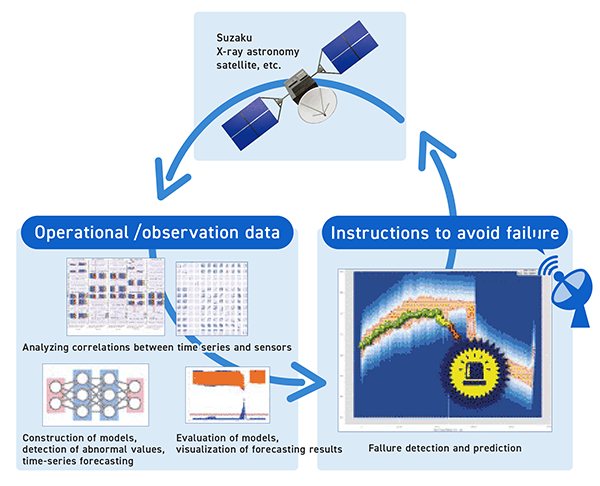
High levels of safety and reliability are required of spacecraft, and operational environments in which danger can be predicted and accidents avoided are desirable. Our research seeks to contribute to stable spacecraft operation by using AI to analyze spacecraft operational data, carry out failure analysis, and accumulate technologies capable of detecting spacecraft failures in advance.
- Solar observatory satellite “Yohkoh”
- X-ray astronomy satellite “ASCA”
- Solar observatory satellite “Hinode”
- X-ray astronomy satellite “Suzaku”
- Advanced land observing satellite “Daichi”
- Greenhouse gases observing satellite “Ibuki”
Etc.
- Mars Reconnaissance Orbiter Ground System
- Asteroid explorers “Hayabusa” and “Hayabusa2”
- Lunar exploration satellite “LUNAR-A”
- Venus climate orbiter “Akatsuki”
- Solar sail demonstrator “Ikaros”
- Space Debris Orbit Generation Experimental System
- Space weather forecasting related systems
- Himawari Real-time Web
- Guerrilla downpour countermeasure support system
- Weather information transmission and processing system
- Quasi-Zenith Satellite Positioning Data Processing System
- Space science database DARTS
- Observation database system for the X-ray spectroscopic imaging satellite “XRISM”
- High-performance hand for space robots (Japan's first space robot)
- Middleware for space robots
- In-ship drone on the International Space Station “Int-Ball2”
- Transformable lunar robot nicknamed “SORA-Q”
- Systems related to Monitor of All-sky X-ray Image (MAXI)
- Systems related to Superconducting Submillimeter-wave Limb Emission Sounder (SMILES)
- Systems related to the International Space Station Japanese Experiment Module
- Nobeyama Radio Observatory Control System
- Subaru Telescope Control and Analysis System
- Solid Rocket Engine High Altitude Test System
- Rocket countdown system (a Japan first)
- Japan Aerospace Exploration Agency (JAXA)
- National Institute of Information and Communications Technology (NICT)
- Domestic private space-related companies (e.g., major electronics manufacturers)
- Space-related start-up companies