At SEC, we carry out activities to contribute toward nurturing the next generation of robotics engineers through our support for the Kibo Robot Programing Challenge (Kibo-RPC).
The Kibo Robot Programming Challenge (Kibo-RPC) is an international programming competition for students, in which participants develop programs to move drone robots inside the International Space Station (ISS) while attempting to solve challenges with the greatest possible speed and accuracy.
Participants can refine their skills in scientific techniques, engineering, and mathematics by developing programs.
They can also develop their capacity as global talent through cross-border mingling with other participants from countries and regions around the world.
- 拡大
- (C)JAXA
Kibo-RPC features preliminary competitions held in multiple locations worldwide using simulators. Teams that win in these preliminary competitions represent their respective countries in the final round, in which they install programs on real drone robots inside the Japanese Experiment Module "Kibo" in the ISS.
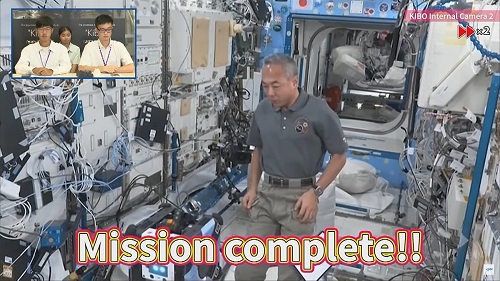
An image from the final round of the challenge (4th Kibo-RPC) at the International Space Station (ISS)
(C)JAXA/NASA
In the 5th Kibo-RPC held in 2024, the competition saw a record number of participating teams and students: 661 teams and 2,788 students from 35 countries and regions.
At the on-orbit final round on November 9, 2024, 13 representative teams that had won their respective regional preliminaries competed by running their own programs to control NASA’s drone robot Astrobee, aiming to reach the goal as quickly as possible while demonstrating accurate image recognition.
The winner was “Astronut,” the team representing Thailand.
The 5th Kibo-RPC(JAXA) : https://humans-in-space.jaxa.jp/en/biz-lab/news/detail/004371.html
Since FY19, SEC has served as a sponsor of Kibo-RPC, has helped develop and run a software platform and portal site that students in Kibo-RPC use to develop programs, and has carried out work to support preliminary competitions in multiple countries.
In addition, SEC holds lectures that adapt the contents of Kibo-RPC for elementary school students to help them easily try out Scratch, a programming language designed for children.
SEC has engaged in software development for space exploration ever since its founding.
The company has worked on many projects, including the onboard systems for Hayabusa2 and other planetary probes and scientific satellites, as well as systems related to the Japanese Experiment Module "Kibo" in the ISS.
In the field of space robotics, SEC has been involved in developing system integration software for "Int-Ball2," an onboard drone that supports astronauts working within the ISS, an operational and management platform for JEMRMS (JEM Remote Manipulator System; robotic arms on the Japanese Experiment Module "Kibo" in the ISS), and other projects.